Every quote we have written this year carries a refrigerant most Cookeville homeowners have never heard of. People see R-454B on the paperwork, search it, find the words “mildly flammable,” and call us back worried.
The short version is that none of this should change your plans. Here is what actually happened, and the one new behavior worth recognizing so you do not mistake it for a breakdown.
Your current system is fine, and you should keep it
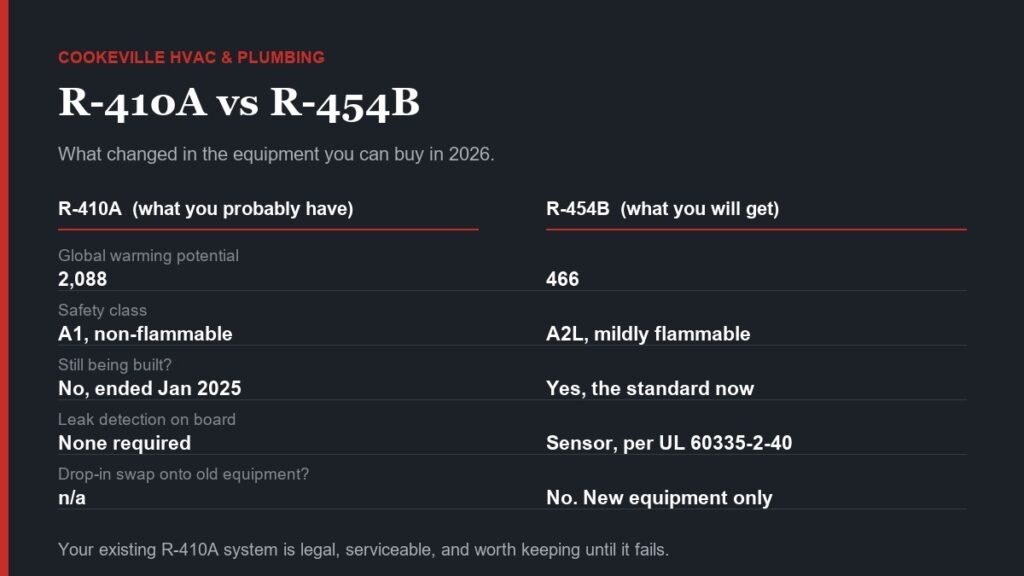
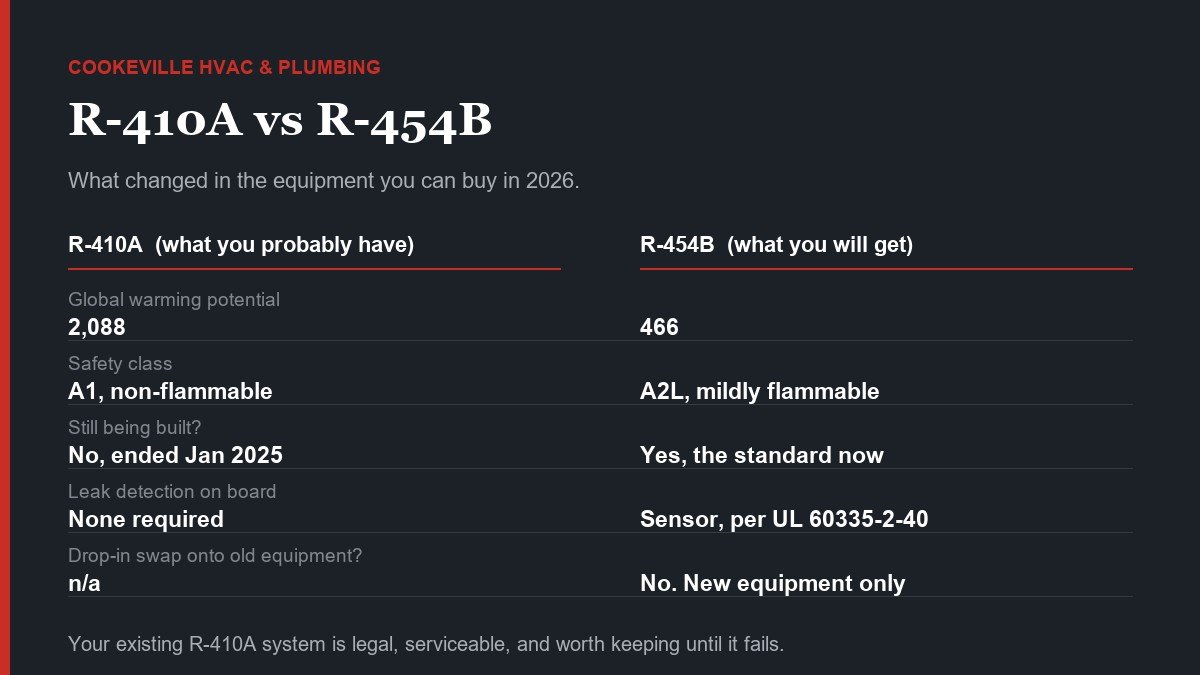
Manufacturers stopped building residential equipment for R-410A at the start of 2025, and the window to install what was left in the warehouses closed at the beginning of this year. That is a rule about new equipment. It is not a rule about your house.
If you have an R-410A system, it is legal, it can be serviced, and R-410A is still on the truck. The only thing that really changes is the price direction. Production is capped, so a pound of it costs more every year. That matters if your system leaks. It does not matter if it does not.
Nobody should be replacing a working system over this. If someone has told you that you have to, get a second opinion.
What “mildly flammable” actually means
R-454B is rated A2L. A1 refrigerants like R-410A do not burn at all. A2L means it can burn, slowly, but only inside a narrow band of concentration and only with a real ignition source sitting in it. It is a good deal harder to light than the propane on your grill, and the conditions it needs essentially do not happen inside a correctly installed system.
The reason for the change is on the other side of the label. R-410A has a global warming potential of 2,088. R-454B is 466, roughly a fifth of it.
What it means in practice is a different install: equipment listed for A2L, tools and recovery gear rated for it, charge limits tied to the size of the room the indoor unit serves, and technicians trained on all of it. That is our problem to solve rather than yours. The part worth asking about is whether the crew showing up is actually A2L trained, because that answer is not universally yes yet.
The blower that runs by itself is not a breakdown
This is the one new behavior worth knowing about before it happens at ten at night.
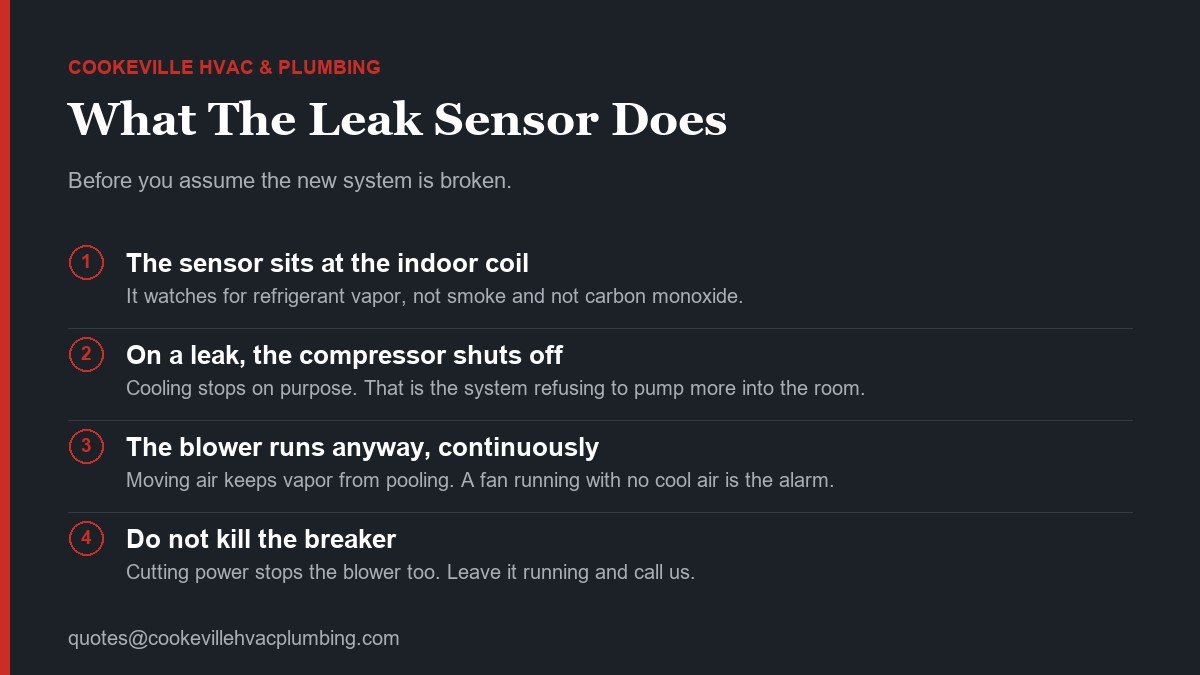
Systems built to the current standard carry a refrigerant sensor near the indoor coil. If it picks up vapor, it shuts the compressor down and runs the blower continuously. Cooling stops and the fan keeps going, which reads exactly like a failure and is the opposite of one. The system has decided to stop moving refrigerant and is diluting whatever got out.
Do not cut the breaker. Killing power stops the blower, and the blower is the part doing the safety work. Leave it running, open a window if it makes you feel better, and call us.
Where this stops being a homeowner question
A house is a forgiving place for a refrigerant leak. A residential system holds a few pounds of it and sits in a building with thousands of cubic feet of air. Even a total loss of charge does not get an occupied room near a dangerous concentration, which is why a sensor and a blower are enough.
Change the room and the math changes completely. A restaurant walk-in, a compressor closet, a mechanical room in a basement: a large charge, a small sealed volume, and no ventilation running unless something switches it on. Refrigerant vapor is heavier than air, so it fills a room like that from the floor up, and the first hazard is not fire. It is that the vapor pushes the breathable air out ahead of it.
Normal air is about 21 percent oxygen. Below 19.5 percent a workplace is officially oxygen deficient, and by the mid teens judgment and coordination are already going. That is the genuinely dangerous part, because the person standing in the room loses the ability to decide to leave it. Spaces like that get a fixed oxygen deficiency monitor mounted on the wall instead of a sensor tucked inside a piece of equipment. Same physics as the one in your air handler, in a room with far less margin.
If you run a kitchen, a cold storage room, or a shop anywhere in the Upper Cumberland with a compressor in an enclosed space, that is worth an honest look. It is the same point we made about where carbon monoxide detectors actually go. A sensor only helps in the room where the problem starts.
What to ask before you sign
Ask whether the technicians doing the install are A2L trained and whether the shop’s gauges and recovery equipment are rated for it. Ask whether your existing line set is being reused, and if it is, how it is being cleaned and pressure tested for the new refrigerant, because that is where a corner gets cut. Ask what the charge limit is for the room your indoor unit sits in, since that is what decides whether a given system is even allowed in that closet.
Then ask what you would have asked two years ago. What happens when it stops working, and who picks up the phone. That part has not changed at all.
Questions about a system you already own, or about a quote you are holding, go to quotes@cookevillehvacplumbing.com.