
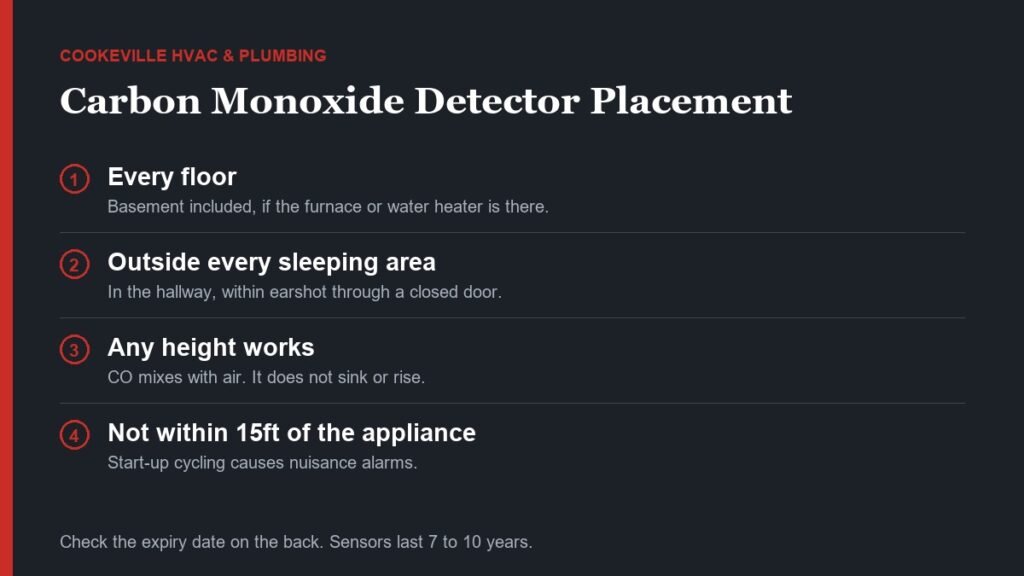
We get asked where the carbon monoxide detector should go about as often as we get asked why the upstairs never cools. The answer is short, but almost every house we walk into has at least one detector in a spot where it is not doing the job it was bought to do.
Here is how we think about it, and the part on the plumbing side that nobody asks about at all.
Height is the myth worth killing first
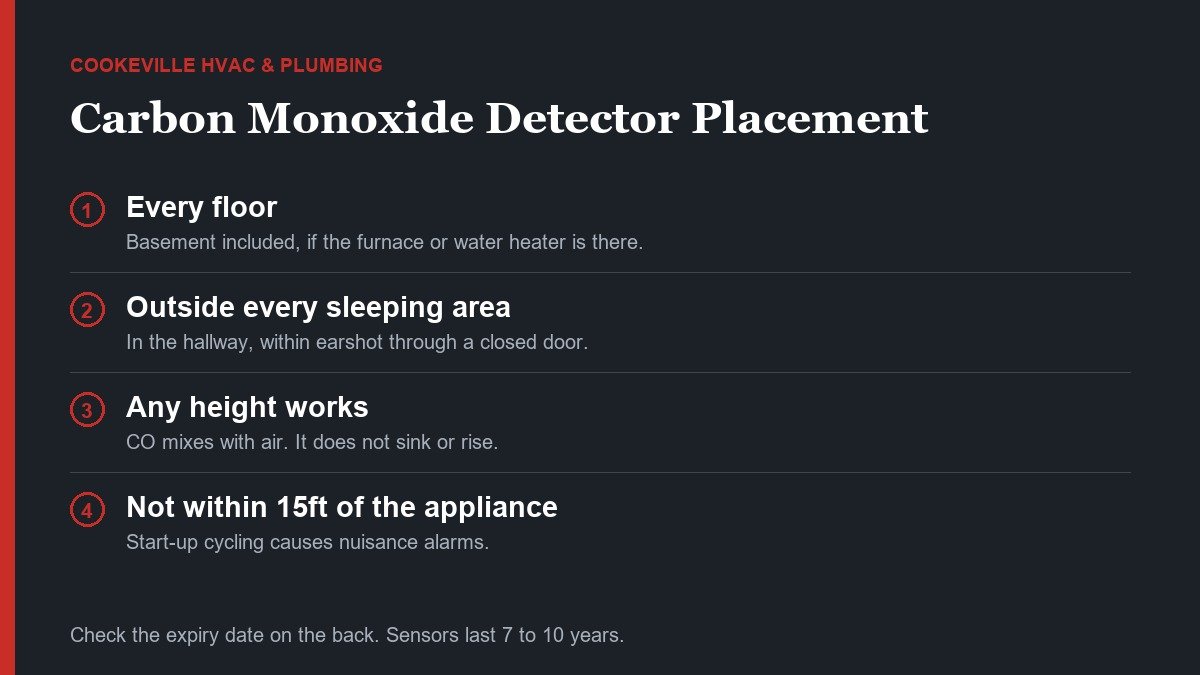
People put CO detectors near the floor because they have heard the gas is heavy, or up at the ceiling because they are thinking of smoke. Neither is right.
Carbon monoxide is very close to the same weight as air, so it mixes rather than settling into a layer. Wherever the air in that room goes, the CO goes with it. That means mounting height is close to irrelevant, and you should put the unit wherever you will actually hear it and actually see the low-battery light. Chest height on a wall, or on a shelf, is fine.
What does matter is distance from the appliance. Put one right beside the furnace and you will get nuisance alarms from normal start-up cycling, and a detector that cries wolf gets unplugged. Give it some room.
The rooms that get skipped
Two places get missed almost every time.
The basement or utility room. If the furnace and the water heater live down there, that is where a venting problem starts. People put a detector in the hallway upstairs and nothing at the source, which means the first warning comes only once the problem has spread through the house.
The wall shared with an attached garage. A cold engine running for two minutes while a door is open puts a surprising amount of CO into the space next to it. If a bedroom or living area shares a wall or a floor with the garage, treat it like an appliance room.
And check the date on the back. CO sensors have a service life, usually seven to ten years, and they expire quietly. A dead sensor inside a unit with a lit green LED is worse than no detector at all, because it is actively telling you everything is fine.
The plumbing half nobody asks about
Carbon monoxide comes from the heating side. On the plumbing side there is a different gas, and the usual cause is a fixture nobody uses.
Every drain in your house has a P-trap, and the water sitting in that bend is the only thing between your living space and the sewer line. In a guest bathroom, a basement floor drain, or a laundry sink that has not run since spring, that water evaporates. Once the trap is dry the seal is gone, and what comes back up is sewer gas, which is mostly hydrogen sulfide.
You will smell it, and that is the good news, because hydrogen sulfide is the rotten-egg gas at low concentrations. The bad news is what happens at higher ones: it deadens your sense of smell within minutes, so the warning disappears exactly when the situation gets worse. That is why industrial facilities monitor it with instruments instead of relying on people noticing, and it is why the specialists at PureAire treat hydrogen sulfide and sulfur dioxide as hazards that need fixed detection rather than a nose.
In a house the fix is free and takes ten seconds: pour a couple of cups of water down any drain you do not use regularly, every month or two. If you have poured water down and the smell comes back within a day, call us, because that is a venting problem rather than a dry trap.
How the industrial side does it
There is a version of this question that gets taken far more seriously than it does in houses, and it is worth borrowing from.
In a lab or a production facility, detector placement is a calculation, not a preference. You work out what gas you are watching for, whether it behaves like air or pools low, where it would enter the room, where people actually stand, and how many units the space needs to have no blind corner. PureAire publish their own guide to how many monitors a space needs and where to mount them, and the logic in it is the same logic that should govern a basement with a gas water heater in it. The stakes are just higher, so somebody wrote it down.
The homeowner version is simpler but it is the same three questions. What could leak, where would it go, and will I hear the alarm from where I sleep.
What we check on a service call
When we are at a house for a furnace or water heater, combustion safety is part of the visit whether or not anybody asked for it:
- Draft and venting. Is the flue actually pulling, and is the connection tight and correctly pitched.
- Heat exchanger condition. A crack is the classic route for combustion gases into the supply air.
- Combustion air supply. Especially after insulation or air-sealing work. A tighter house changes how an appliance draws, and a starved appliance is a dangerous one.
- Detector inventory. Where they are, whether they work, and how old they are.
If it has been more than a year, our Tennessee tune-up checklist covers what a proper service visit should include. And if the reason you are reading this is a smell rather than curiosity, we have written about what the first 48 hours should look like when something has gone wrong with water.
If you are not sure whether your detectors are in the right places, ask us at the next service call. It takes two minutes and it is free.