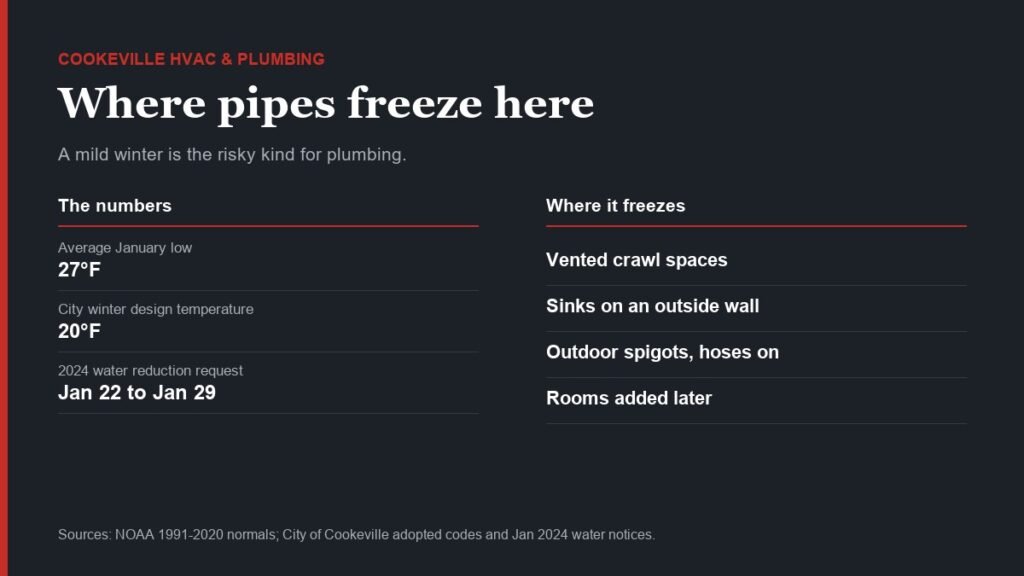
In January 2024 the City of Cookeville asked every customer on its water system to cut back on water. The cold had frozen and burst pipes, and once the lines thawed the leaks drove usage so high that the city said its plant was producing all it was capable of treating. The city also reported finding leaks on the customer side of the meter, in people’s own lines. The request covered Cookeville, Algood, Baxter and four utility districts, started January 22, and was not lifted until January 29, when tank levels got back to normal (first notice, update, all clear).
That is why this post is going up in October and not in January. The short answer: keep the heat at 55°F or higher, open sink cabinets on outside walls, let the faucets drip when the forecast turns hard, and shut off and drain your outside spigots before the first freeze. Everything below is the reasoning, and the order to do it in.
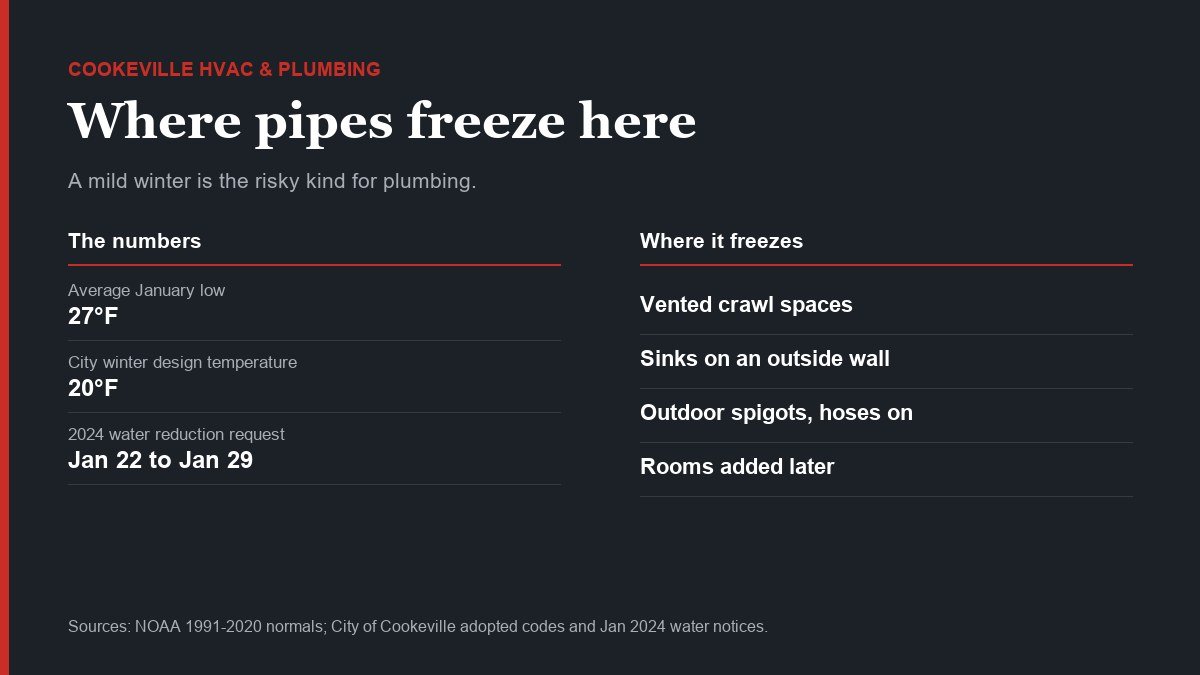
A mild winter is the risky kind for plumbing
Cookeville is not a cold town on paper. The average January low is 27°F (NOAA 1991 to 2020 normals, via Current Results), and the city’s codes division sets the winter design temperature for houses here at 20°F (City of Cookeville adopted codes).
That is exactly the problem. Houses are built for the winter they usually get. Supply lines run through vented crawl spaces and along outside walls with little or no insulation, because most nights that is fine. The pipe does not freeze on an ordinary January night. It freezes on the few nights that drop well below the average, usually with wind behind them.
The Insurance Institute for Business and Home Safety says it plainly in its winter checklist: southern regions are more susceptible to plumbing issues during extreme cold, while northern regions worry more about snow loads (IBHS Winter Ready home checklist). Northern houses are built expecting the cold. Ours are not.
Where pipes actually freeze in Upper Cumberland houses
When we get the call, the frozen section is almost always in one of these places:
- The crawl space. A lot of homes around Cookeville sit on vented crawl spaces, often on a slope where one side is open to the wind. Cold air comes through the vents and any gap in the rim, and it finds the supply line first.
- Under a sink on an outside wall. Kitchen sinks under a window are the classic case. The cabinet door stays shut, the room stays warm, and the pipe behind the cabinet does not.
- Outdoor spigots. IBHS notes that homes built before 2010 typically do not have frost-proof outdoor faucets. If a hose is still attached, the water trapped in it can freeze back into the wall.
- Rooms added later. A bathroom in a garage conversion, a wet bar in a bonus room, plumbing in an addition that was never tied into the main heating. We covered the heating side of that in conditioning a sunroom or addition, and the same blind spot applies to the pipes.
What to do in October, before the first hard freeze
These are the jobs that take an afternoon now and save a ceiling later. Most come straight from the IBHS checklist; the last one is ours.
- Insulate exposed pipes in the crawl space, the attic and along outside walls. Foam pipe sleeves are cheap and they work.
- Seal where cold air gets in. IBHS calls out the penetrations around vents, plumbing, piping and wiring that pass through an exterior wall. A gap you can see daylight through is a gap the wind can use.
- Disconnect hoses and drain the outside faucets. If your spigots are not frost-proof, shut off their valve inside the house and open the faucet outside to drain it.
- Cover the crawl space vents temporarily for the cold season. Take the covers off again in spring, because a crawl space here needs the airflow once the humidity comes back.
- Find your main water shutoff and make sure it turns. The worst time to learn where it is, or that it is seized, is with water coming through a light fixture.
The night the forecast drops into the teens
When a hard cold snap is coming, IBHS gives three steps, and all three are worth doing:
- Keep the thermostat at 55°F or higher. That includes when you leave town. Turning the heat off to save money while you are away is how a lot of burst pipes start.
- Open the cabinet doors wherever plumbing runs along an outside wall, so the room’s heat can reach it.
- Let the faucets drip during the extreme cold. Moving water is harder to freeze, and an open faucet gives pressure somewhere to go.
One more step the 2024 freeze taught this town: once it warms up, turn the drips off. Once temperatures rose, the city specifically asked customers to stop running water to keep pipes from freezing, and to hold off on washing cars, so the system had time to recover. Every faucet left dripping after the cold has passed is water the tanks are still trying to replace.
When you turn on the tap and nothing comes out
No water, or a trickle, on a very cold morning usually means a frozen line somewhere between the meter and that faucet. The IBHS advice is to shut off the water supply and call a plumber, and the order matters.
Shut the main off first. A frozen pipe often splits while it is frozen, and you do not find out until it thaws. That is what happened across this water system in 2024: in the city’s own words, as the lines thawed, leaks presented themselves. If the main is closed when the ice lets go, a split pipe leaks a little instead of running all afternoon.
Then warm the area gently. Open the cabinet, raise the heat, point a space heater at the cabinet from a safe distance. Do not put a torch or any open flame on a pipe, especially in a crawl space full of dry framing.
If a line has already burst, the clock on water damage starts immediately. Water damage: the first 48 hours covers what to do and in what order.
Worth a look before winter
If you are not sure what is under your house, the fall is the time to find out. We would rather spend twenty minutes in your crawl space in October than show up in January to a split line and a wet subfloor. Our Tennessee HVAC maintenance checklist covers the heating side of the same visit.
Questions about your pipes, your crawl space or a system you already own go to quotes@cookevillehvacplumbing.com. See our services.